
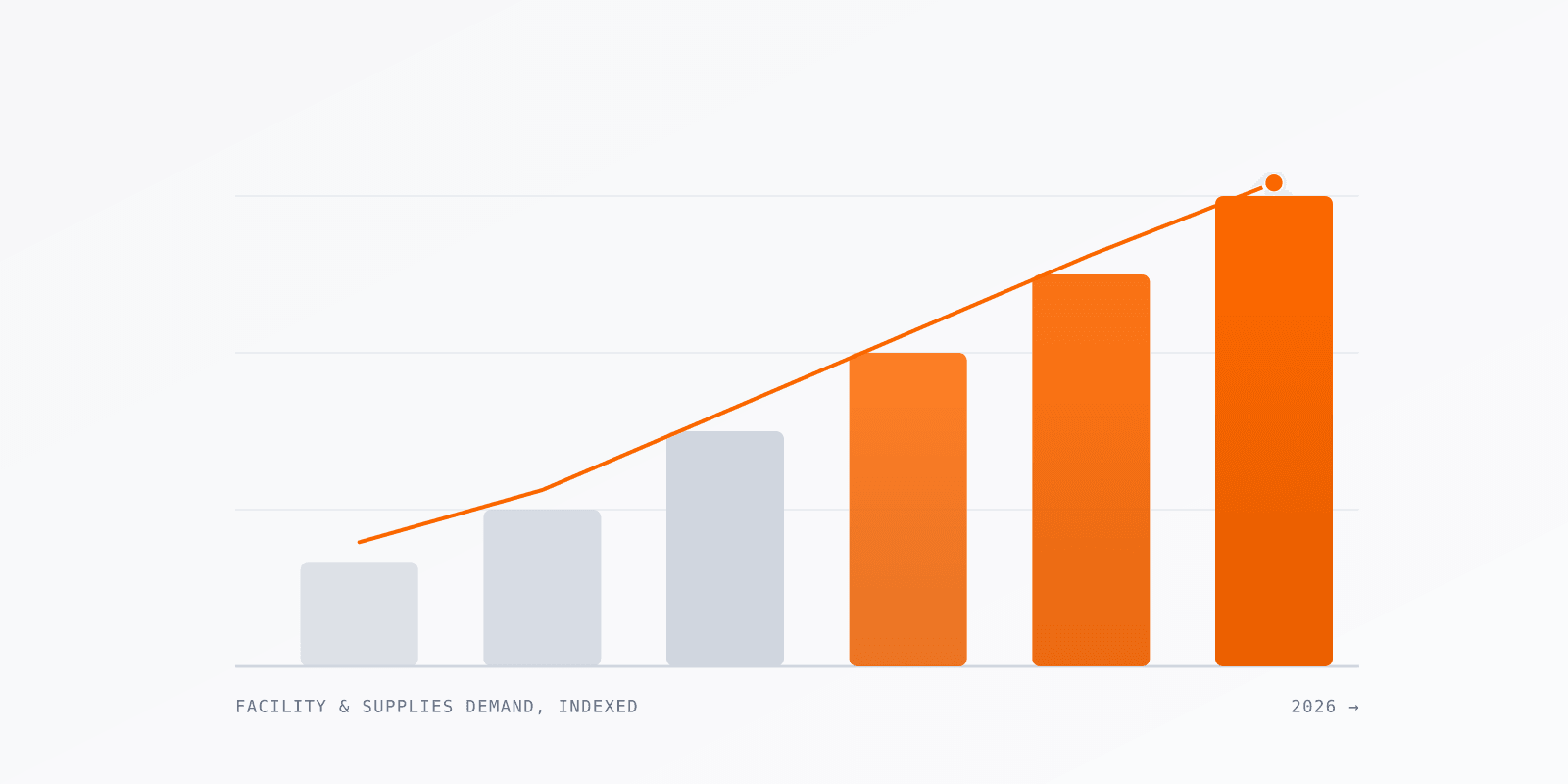
If you sit in procurement, facilities or finance, you don't need a research report to tell you office and facility spend has changed shape over the last few years. But it helps to see the numbers behind what you're already feeling on the ground, and to know where the market is heading next.
The market is bigger, and growing faster, than it looks
India's facility management market is estimated at roughly USD 87 billion in 2026, on track to reach around USD 124 billion by 2031 (a compound annual growth rate near 7.3%), according to Mordor Intelligence. Other research houses estimate the market even higher: Fortune Business Insights puts India's 2026 figure closer to USD 155 billion. The gap between estimates comes down to how each firm defines "facility management," but every methodology points the same direction: up, and faster than general economic growth.
The office furniture segment specifically is estimated at USD 5.2–6.4 billion for 2026 depending on the source (Mordor Intelligence, Fortune Business Insights), with hybrid workspace design and ergonomic demand cited as the primary growth drivers.
Flexible space is no longer a startup habit: it's mainstream
The clearest structural shift in the market is the move toward flexibility. India's flexible office stock is projected to cross 100 million square feet in 2026, according to Cushman & Wakefield, with flex operators expected to account for 20–25% of all office leasing activity this year. Large enterprises, not just startups, are now using coworking and flex space for satellite offices, project teams and regional hubs, reporting real estate cost reductions in the range of 30–50% through hybrid strategies.
That shift doesn't stay contained to real estate. Every flexible office still needs desks, chairs, pantry supplies and facility consumables, just provisioned on a timeline that matches the lease, not a decade-long capex cycle. This is the direct link between the flex-space boom and growing demand for furniture and equipment rental specifically, rather than outright purchase.
What's driving the growth
- Hybrid work has stabilized, not disappeared. Most large employers have settled into a hybrid model rather than reverting fully to office-first, which keeps demand for flexible, scalable facility setups elevated rather than temporary.
- Employee expectations are shifting the calculus. Roughly 78% of Indian professionals expect workplace flexibility, with a meaningful share saying they'd change employers for it, pressuring companies to invest in better-equipped, more adaptable office environments to stay competitive on talent.
- Tier-2 city expansion. Bengaluru still leads flexible office stock nationally, but Delhi-NCR, Pune and Hyderabad are close behind, and smaller cities are increasingly part of expansion plans, each one a fresh procurement and setup cycle.
- Digitization of procurement itself. GST e-invoicing, digital vendor onboarding and marketplace-style B2B buying are replacing manual, relationship-based purchasing, making it easier to compare, consolidate and track facility spend centrally.
What this means if you're buying, not researching
- Budget for flexibility, not just growth. If your organization is moving toward hybrid or flex space, your facility and furniture spend should be structured to scale up and down, not locked into long fixed commitments.
- Expect more, smaller setups rather than one big office build-out. Satellite offices and regional hubs mean procurement needs to support repeatable, fast setups across multiple small locations.
- Vendor consolidation matters more as the market fragments geographically. More locations without a consolidated supplier multiplies admin overhead fast.
The number worth remembering: this is a market growing at a mid-to-high single-digit CAGR on a base already worth tens of billions of dollars, with flexibility, not permanence, as the dominant theme. Companies that build procurement and facility strategy around that shift, rather than around a static five-year office plan, are the ones set up to move fast when the next expansion or contraction comes.
Data referenced from Mordor Intelligence, Fortune Business Insights and Cushman & Wakefield India Office Market research, 2026, linked above at each figure.